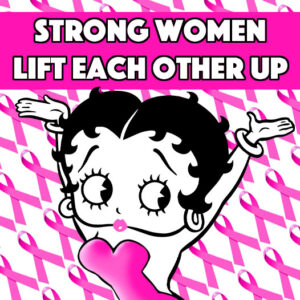
 WOMEN STANDING TOGETHER
Welcome back to the Blog everyone. It’s once again October in which the days grow shorter, the nights cooler, the falling leaves are plentiful, and the upcoming holidays fill our awareness with anticipation.
Yet, October is also BREAST CANCER AWARENESS MONTH, a time when we pause and reflect on the wellbeing and health of all the women in our lives.
Every year at this time, I invite my co-host, the iconic cartoon character Betty Boop, to join me in delivering an important message on the subject as breast cancer strikes over 200,000 women every year. As a breast cancer survivor myself, this cancer is one I take very seriously and very personally.
As a member of my family-owned business, Fleischer Studios, Betty Boop and our entire Studio team, have always championed women’s causes and have been devoted proponents in raising awareness for the health issues faced by women every day such as breast cancer.
Treating and beating this disease is, of course, based on many factors. And one of the most important of these are the risk factors associated with this disease of which we will review 7 of the most important.
GENDER
It’s important to note that breast cancer is an equal opportunity disease. Interestingly, it can affect both women and men. However, it occurs approximately 100 times more often in women than men.
REPRODUCTIVE HISTORY
In short, the longer a woman’s lifetime cycle of menstruation lasts, the greater the risk for breast cancer becomes. Experts agree that if we experienced our first period at an early age and we experience menopause at a later age, our risk for breast cancer is greater. In addition, women who never had children or who had a child later in life also have an increased risk for this disease.
PERSONAL MEDICAL HISTORY
For those of you like me who have already experienced one breast cancer, our risk of developing another breast cancer is greater. And having breast cancer in one breast can indicate a greater risk for developing a future cancer in the other breast. In addition, fibrosis, a condition which refers to dense breast tissue, increases one’s risk because it can hide a cancerous tumor making detection more difficult.
FAMILY MEDICAL HISTORY
Women who have a first degree relative, which includes a parent, sibling or child who have had breast cancer have an increased risk for developing the disease as well. This is especially true if that relative was diagnosed before the age of 50.
GENETIC ANOMALY
Most of us are familiar with the BRCA1 and BRCA2 genes. If these genes carry an anomaly, known as a mutation, one’s risk for breast cancer increases significantly. If you have a family history of breast cancer and if you are of Ashkenazi Jewish descent, you may have an anomaly of these genes. If so, your risk for breast cancer not only increases, but also your risk for ovarian cancer.
AGE
One of the most important factors is that as we age, we become more susceptible to many diseases, including cancer. Typically, breast cancer affects women over the age of 55.
RACE
There are many types of breast cancer. With a few exceptions, most types are more common among Caucasian women than women of other races. However, Black women are more susceptible to developing more advanced and lethal breast cancers.
 Yet, awareness of the risks for breast cancer is only part of the puzzle. It’s important to be familiar with the proper preventative procedures and lifestyle choices as well. And here are 8 of the most important.
- Mammograms
- Screening Ultrasounds
- Self-exams
- Annual visits with one’s primary physician
- Proper diet
- Exercise
- Alcohol in moderation
- Eliminating tobacco use
 Preventative measures go a long way in reducing our risk for breast cancer and our best defense is always a strong offense. Knowing our options will always help us make informed decisions regarding our healthcare and protecting our lives. And as Betty and I always say, “Don’t be afraid. Be informed.”
As women, we are all in this battle together. We honor those we have lost. We support those who are still in the fight. And we stand united in our strength together!
In closing, thanks to everyone joining me today and until next time, stay safe, stay strong, stay in GOOD HEALTH and . . .
TAKE THE COURSE AND TAKE CHARGE!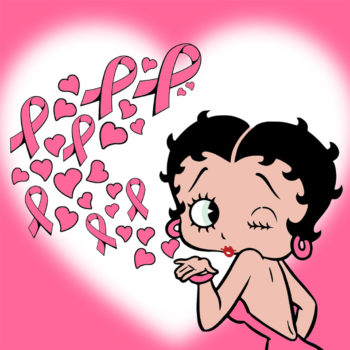

Leave a Comment